Mental Status Examination
Detailed history taking, clinical interview and mental status examination remains the corner stone for good clinical practice in psychiatry.
Assessing the reliability of history received from the care giver:
- It has to be coherent
- It has to be chronological
- It has to be consistent
- The caregiver should be concerned about the patient and close enough to have lived or spent time together atleast in the recent times
Important aspects of the individual to be assessed during the mental status examination are:
- General appearance & behaviour
- Eye Contact
- Rapport
- Psychomotor activity
- Speech
- Thought
- Mood
- Perceptions
- Attention
- Concentration
- Orientation
- Memory
- Judgement
- Insight
Delusions
Delusion is a false and fixed belief.
Important types of delusions:
- Somatic type: Delusion related to their body, e. g., delusional parasitosis.
- Persecutory type: Most common type of delusions, characterized by the belief that he is conspired against.
- Grandiose type: Exalted ideas about self.
- Jealous type: Delusion that the spouse is not faithful.
- Erotomanic type: Delusion that a person, usually from a higher status, is in love with them.
Thought disorders
Important components of healthy thinking:
- Constancy
- Continuity
- Organization
4 important thought disorders:
- Thought form disorder
- Thought stream disorder
- Thought content disorder
- Thought possession disorder
Examples of thought form disorder are:
- Loosing of association
- Word salad
- Tangentiality
Types of formal thought disorder are:
- Transitory thinking (problems in constancy)
- Drivelling (problems in organization)
- Desultory thinking (problems in continuity)
Examples of thought stream disorder are:
- Flight of ideas
- Prolixity of speech
- Circumstantiality
- Thought block
Examples of thought content disorder are:
- Ideas
- Overvalued ideas
- Delusions
Examples of thought possession disorder are:
- Thought insertion
- Thought broadcast
- Thought withdrawal
Note:
Undirected fantasy thinking is also called as dereistic or autistic thinking.
Hallucination
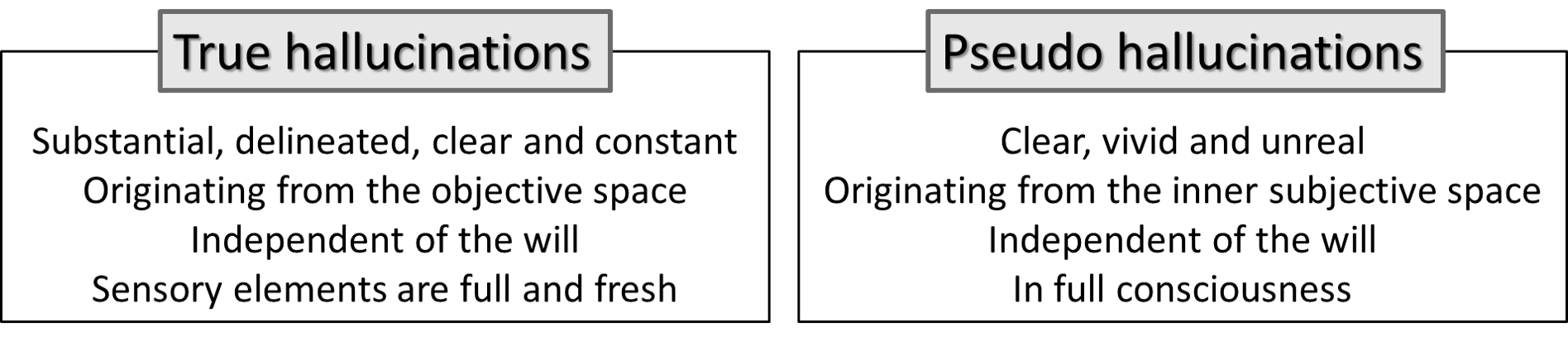
Difference between true and pseudo hallucination:
Note:
Pseudo hallucination is a type of imagery.
Imagery is an incomplete, non-delineated, and unclear perception which has to be recreated. It originates from the inner subjective space and under voluntary control.
There are 3 important types of special hallucinations:
- Extracampine hallucination
- Reflex hallucination
- Functional hallucination
Extracampine hallucinations:
These are the hallucinatory experiences, wherein the source of the hallucinations is beyond the normal sensory field. Example: A person with auditory hallucinatory experience reports that the source of voices is about 20 km away.
Reflex hallucinations (synesthesia like):
The real stimuli and the hallucinatory experience are in different modalities. Example: Whenever the Church bell rings (real), the person has bad taste (hallucination) on his tongue.
Functional hallucinations:
The real stimuli and the hallucinatory experience occur in the same modality. Example: When the water tap is opened, the person hears water flowing (real) as well as commanding or commentary voices (hallucination). Once tap is stopped, the voices stop.
Hypnogogic hallucinations are the hallucinatory experiences occurring when one is going to sleep.
Hypnopompic hallucinations are the hallucinatory experiences occurring when one is getting up from sleep.
Hypnogogic and hypnopompic hallucinations can occur in normal people.
Lilliputian hallucinations:
It is a state of visual hallucinations, wherein, the visual experiences are microscopic in nature and not of real size. Common cause of this is delirium.
Charles Bonnet syndrome:
It is characterized by complex visual hallucinations in the absence of psychiatric illness. It is usually associated with visual impairment.
Mood
Mood vs. Affect:
Even though most of the times the words are used interchangeably, there is a small difference between mood and affect.
Mood - is the quality of emotions experienced at a particular moment, or it is the crossectional experience.
Affect - is the quality of emotions over a period of time, or it is an experience over a significant period of time.
Important qualities of mood experienced by the individual are:
- Euthymic
- Dysthymic
- Depressed
- Euphoric
- Elated
- Esctacy
- Dysphoric
Normally the affect of the individual is reactive, means their emotions change based on the context and content of discussion.
Decreased reactivity is seen in Depression and blunted affect is characteristic of Schizophrenia.
Congruence of mood is commented based on the sync between the contents of the thought process and the associated mood state. Incongruence in affect is seen commonly in patients with Schizophrenia.
Experience of self
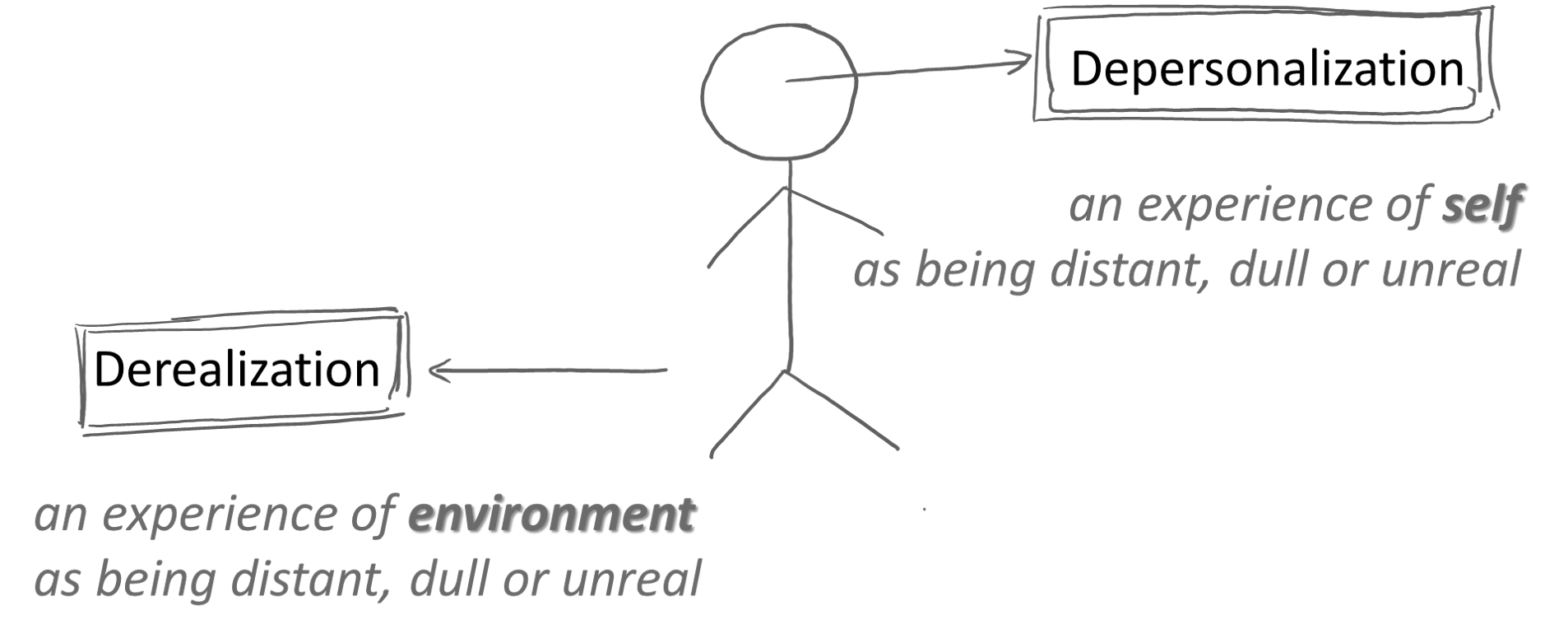
Depersonalization and Derealization are both as if phenomena.
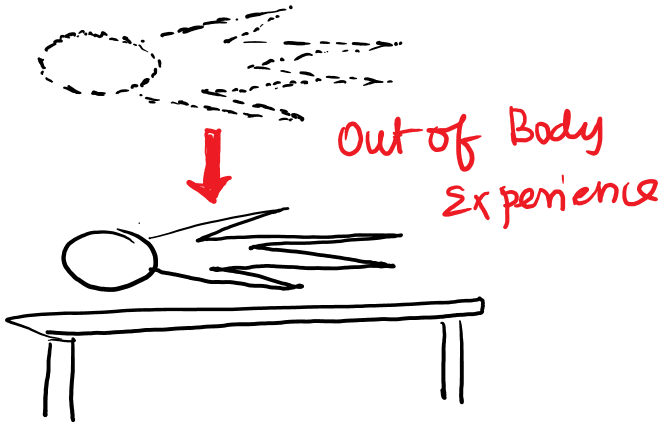
Out of body expereince:
Able to see ones real self from outside, through another body.
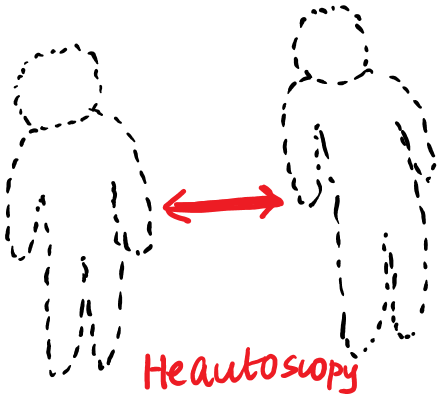
Heautoscopy:
Able to see two selves but unable to distinguish the real from the unreal.
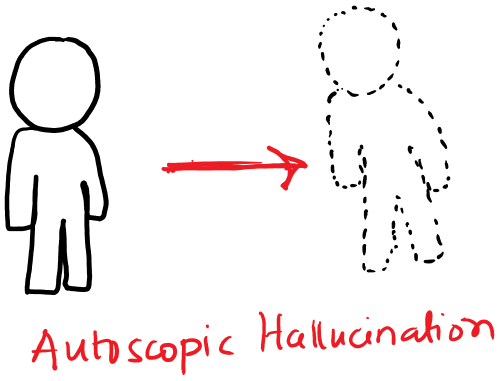
Autoscopic hallucination:
Hallucinatory experience of seeing ones own self.
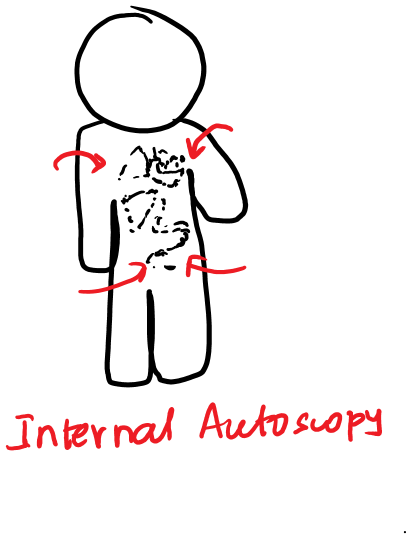
Internal autoscopy:
Able to see ones own internal organs through the skin.
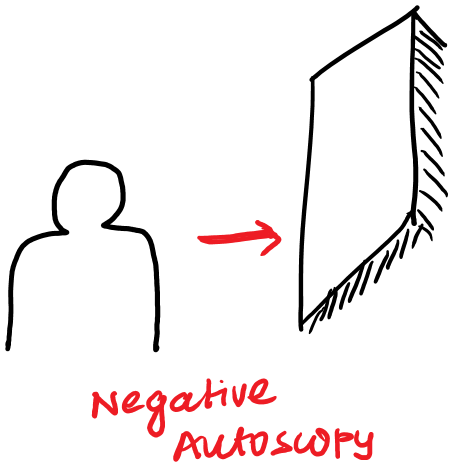
Negative autoscopy:
Unable to see ones own reflection in the mirror.
Attention and Concentration
Sustained attention = Concentration
Attention is assessed in MMSE by 2 methods:
- Spell the word 'WORLD' in reverse order
- Serial subtraction of 100-7
Note:
Digit repetition is a test for immediate memory.
Memory
Memory involves 3 processes:
- Encoding
- Storage
- Retrieval
Amnesia = Loss of memory
Paramnesia = Distortions of memory
Memory consolidation occurs during the rapid eye movement (REM) phase of sleep.
Bilateral temporal lobe lesion can lead to complete amnesia.
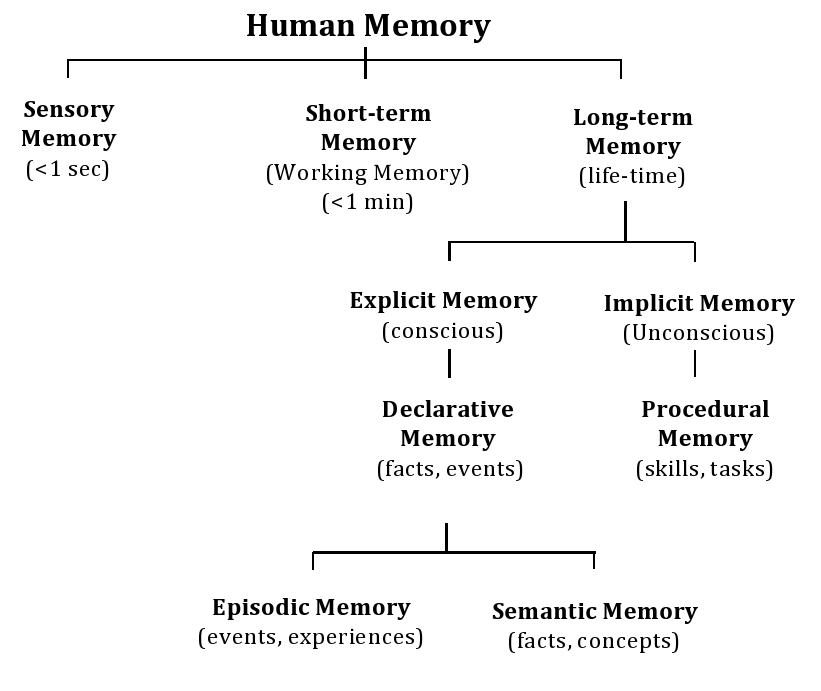
Types of memory:
Abstract vs. Concrete thinking
Normal individuals have abstract thinking abilities.
Concrete thinking is a characteristic finding in Schizophrenia.
Tests used to assess abstract and concrete thinking are:
- Similarities test
- Dissimilarities test
- Proverb test
Insight
Insight is the conscious awareness or recognition of ones own condition. The term Insight was given by Karl Buhler, a German Psychologist.
It is also called as Epiphany.
Multi Dimensional Model of Insight, three main dimensions:
- Recognition of illness
- Accepting the need of treatment
- Understanding the abnormality of the symptoms (accepting pathological basis)
Grades of Insight:
- Complete Denial
- Fluctuates between denial and slight awareness
- Awareness but blames the cause to non illness aspect
- Intellectual Insight (Aware. accepts and doesn't acts upon)
- Emotional Insight (Aware accepts and acts upon)
Possible explanations for loss of Insight:
- Psychological defense - Insight loss acts as a defense against possible depression or anxiety, related to the abnormal behaviors/experiences.
- Cognitive deficit - Insight loss is secondary to the illness progression leading to cognitive deficits, hence the awareness about illness.
- Neuro-Psychological deficit - Insight loss is due to frontal lobe dysfunction and impaired executive functioning.
Anosognosia, a extreme form of loss of insight is known to happen with right parietal lobe lesions. These are suggestive of loss of insight being linked to neuropsychological deficits possibly in frontal and/or parietal lobe.