Importance of mental illness
- 1 in 4 adults have mental health issues
- The most productive years of life, 30 – 49 years, are affected
- 15% of the global disease burden is estimated due to mental illness
- Mental illnesses can increase the chances of premature death
The term psychiatry was coined by Johann Christian Reil.
Check out this video on important aspects related to the National Mental Health Survey 2016, @ https://youtu.be/4rjZRgiNZSc
Mental Wellbeing
A state where in an individual is able to:
- Cope with hassles and stressors of life
- Works productively and realizes abilities
- Contributes positively to the community
Mental Illness
It is characterized by the presence of significant alterations in behaviours, emotions, and thoughts, leading to distress to self or others around them.
The mental illnesses can divided into common and severe types.
Common mental illness are:
- Substance use disorders
- Anxiety disorders
- Depression
Severe mental illness are:
- Schizophrenia
- Bipolar disorder
- Other forms of psychosis
The mental illnesses can divided into neurotic and psychotic types.
Neurotic illness are characterized by:
- Presence of judgement
- Presence of insight
- Intact personality
- Contact with reality
- Example - Generalized anxiety disorder
Psychotic illness are characterized by:
- Impaired judgement
- Absence of insight
- Personality deterioration or significant change
- Loss of contact with reality
- Example - Schizophrenia
The mental illnesses can divided into organic and non-organic(functional) types.
Organic illness are those where there is significant and gross pathology underlying the illness. Example - Dementia, Delirium, Organic personality change
Note:
The most common organic mental illness is Delirium.
The most common hallucination in organic mental illness is Visual hallucinations.
Neurotransmitters
Important neurotransmitter and their main source:
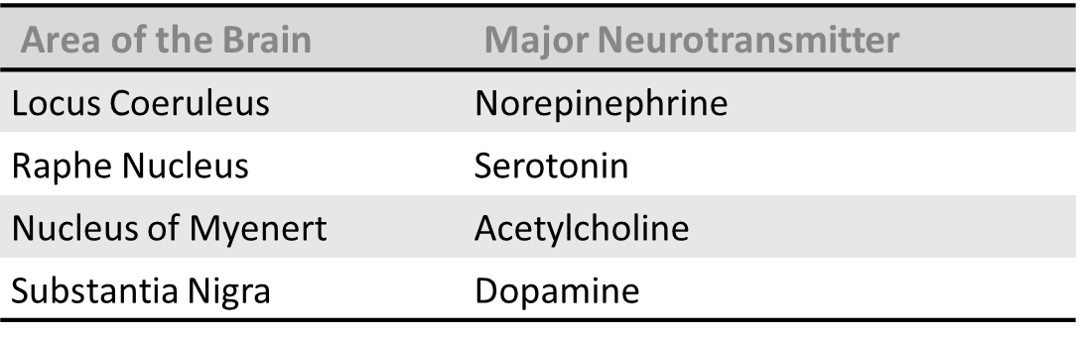
Neurotransmitters and mental illness:
Depression - Decreased Serotonin, Norepinephrine and Dopamine
Mania - Increased Serotonin, Norepinephrine, and Dopamine
Anxiety Disorders - Decreased Serotonin and GABA
Schizophrenia - Increased Dopamine
Parkinson Disease - Decreased Dopamine
OCD - Decreased Serotonin and Norepinephrine
Dementia - Decreased Acetylcholine
Huntington chorea - Decreased GABA
Dopamine pathways
4 important dopamine pathways are:
- Mesocortical pathway (role in negative symptoms of schizophrenia)
- Mesolimbic pathway (role in positive symptoms of schizophrenia)
- Nigrostriatal pathway (role in extrapyramidal symptoms)
- Tuberoinfundibular pathway (role in producing hyperprolactinemia)
Papez circuit
- A circuit begins and ends at the hippocampus
- It is also called as Hippocampo-mamillo-thalamic tract
- It is bilateral, symmetrical and in the medial side of the brain
- Important parts of the circuit:
- Mamillary body
- Anterior Thalamic nuclei
- Cingulate gyrus
- Hippocampus
- It was thought to be circuit of emotions, but now it is known that it has no role in emotions. It is more involved in episodic memory acquisition and spatial mapping.
Note:
Amygdala is not part of the classical papez circuit.
Check out this video on Papez Circuit @ https://youtu.be/un35b489Qr0
Reward circuit
Important components of the reward circuit are:
- Ventrategmental area
- Nucleus accumbens
- Prefrontal area
Duration of illness as diagnostic criteria
Check out this video on important aspects related to various illness duration @ https://youtu.be/I-0xDAJrY7Q
Important aspects about DSM5 and ICD11
- Spectrum based understanding of the illness
- Neurobiology emphasis
- Life span approach
- DSM 5 criteria are followed in USA (Check out this video on 'Know your DSM5' @ https://youtu.be/_gWcL9E7C0E)
- ICD 10/11 diagnostic criteria are followed in the rest of the world, including India.
- The subtypes of Schizophrenia have been squashed and catatonia is a separate diagnostic entity
- Complex PTSD and Prolonged Grief Disorder are important additions to ICD 11
- Hoarding disorder is no more a subtype of OCD, but considered a separate entity under OCD
- Somatoform/Somatization disorder types have been trashed and brought into simple category of Bodily Distress Disorder (in ICD 11) or Somatic Symptom Disorder (in DSM 5)
- Illness anxiety disorder is the newer term for Hypochondriasis
- The term mental retardation has been replaced by the term Disorder of Intellectual development (in ICD 11) and Intellectual Developmental Disorder (in DSM 5)
- Types of autism are squashed and all the subtypes come under the bandwidth of Autism spectrum disorder
- Gender Identity Disorder in DSM 4 and ICD 10 is now called as Gender Incongruence (in ICD 11) and Gender Dysphoria (in DSM 5)
- Gaming Disorder (online and offline types) is an addition to ICD 11
- DSM 5 has been in use since May 2013, whereas ICD 11 shall be in vogue from January 2022.