Catharsis vs. Abreaction
Abreaction:
A process by which repressed material, particularly a painful experience or conflict, is brought back to consciousness. During the process, the person not only recalls, but also relives the material, which is accompanied by the appropriate emotional response; insight usually results from the experience.
Catharsis:
The expression of ideas, thoughts, and suppressed material that is accompanied by an emotional response that produces a state of relief in the patient.
Note:
Abreaction and catharsis are almost similar, the emotional loading and level of retrieval is more in abreaction compared to catharsis.
Transference vs. Counter Transference
Transference and counter-transference are 2 issues very important in doctor—patient relationship, and it is not a defense mechanism.
Both occur based on the past experiences with significant others and can be positive or negative in nature. The only difference is that transference occurs in patients whereas counter-transference is seen in health professionals.
In simple terms transference is the feelings which the patient expresses towards the therapist based on his own past experiences, example while talking to a client imagine I tell him it is good if you consider going to walk regularly, in a moment the patient reacts to say “you are talking like my father, you are always advising, that is why I hate my father” this is transference. These kind of reactions if recognized by the therapist could help the therapist to understand the inner processes of the client and work on the same.
Road to unconscious
- Hypnosis
- Slip of tongue
- Free association
- Dream interpretation
Important therapies
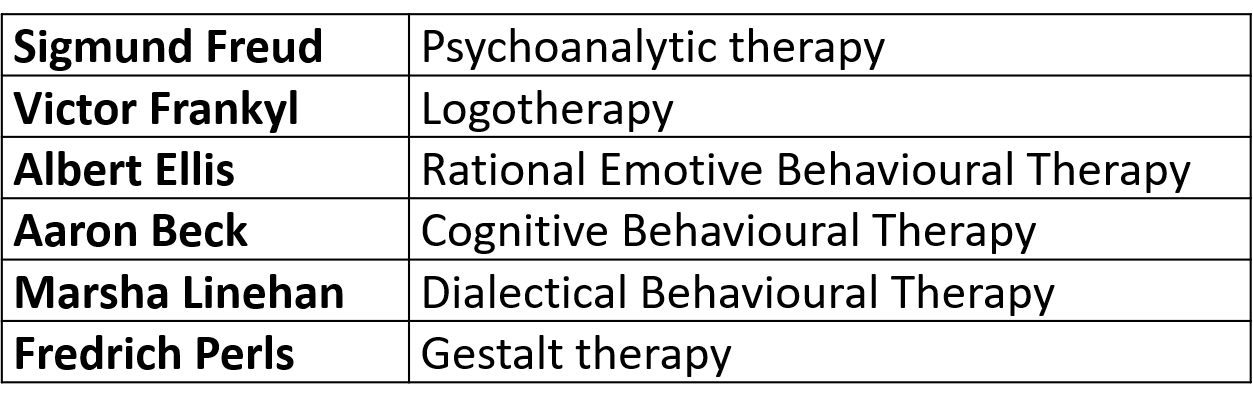
Specific therapies for specific conditions
Phobia:
Flooding
Systematic desensitization
Substance use disorder:
Motivational interviewing
Assertiveness training
Relapse prevention
Craving management
CBT
PTSD:
Eye movement and desensitization and reprocessing (EMDR)
Borderline personality disorder:
Dialectical behavioural therapy (DBT)
Learning disability:
Remedial training
Somatic symptom disorder:
Reattribution therapy
Existential crisis:
Logotherapy
Obsessive Compulsive Disorder:
Exposure response prevention (ERP)
Cognitive Behavioural Therapy
It is one the most widely used evidence based and effective therapy in the contemporary world. It is based on the CBT triangle.
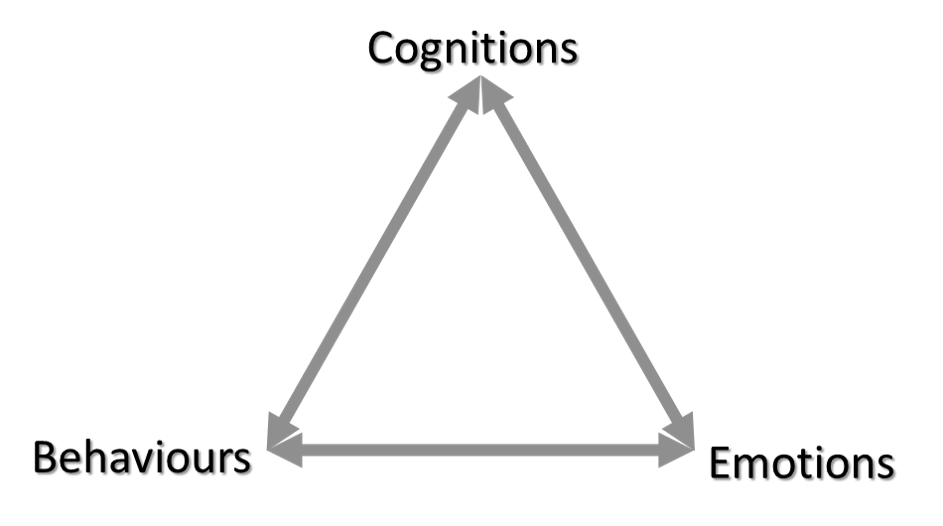
In CBT, the therapist works at 3 levels:
1. Dealing with automatic thoughts.
2. Dealing with cognitive errors.
3. Dealing with deep rooted schema.
Some of the important thought errors seen in individuals are:
- Over generalization
- Fortune telling
- Labeling
- Negative abstraction
- Dichotomous thinking
- Mind reading
- Magnification
- Must and should thinking
Note:
Socratic questioning is a method used in CBT to delve deeper into the cognitive process.