Obsessive Compulsive Disorder
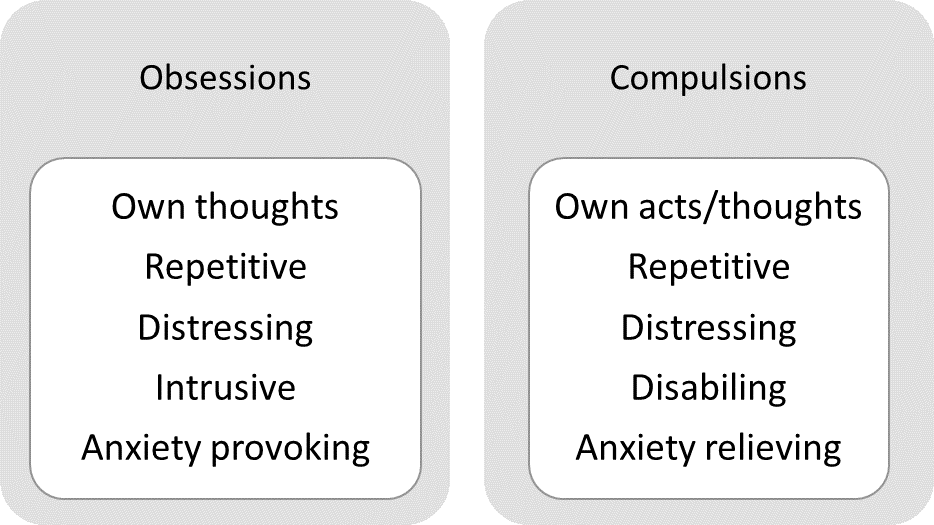
Most common obsession – Fear of contamination (mysophobia)
Most common compulsion – Washing
Important defence mechanisms in OCD:
- Reaction formation
- Isolation
- Undoing
Pharmacological management of OCD:
- SSRIs, Dual acting antidepressants, Bupropion and Clomipramine are used.
- Clomipramine has more anti-obsessive property compared to SSRIs. But SSRIs are preferred initial drugs to be considered due to better tolerability.
- Augmentation is commonly done with low dose antipsychotic or clonazepam.
Important side effects related to Clomipramine:
- Dryness of mouth
- Constipation
- Blurred vision
- Cardiac arrhythmias
- Urinary retention
- Orthostatic hypotension
- Decreased seizure threshold
Exposure Response Prevention (ERP):
Useful behavioural therapy for managing OCD. It is used in combination or standalone treatment for OCD. It is based on the principle of habituation and learn to cope adaptively with high levels of anxiety
Surgical interventions for resistant OCD:
- Limbic leucotomy = Anterior cingulotomy + subcaudate tractotomy
- Deep brain stimulation
Trichotillomania
- It is also called as the Hair pulling disorder.
- In DSM 5, it is included as a condition under the category of Obsessive Compulsive and Related disorders.
- In ICD 11, it is a disorder coming under the category Body Focussed Repetitive Behaviour Disorder.
- It is a chronic condition with uncontrollable urge to pull hair.
- The common sites of hair pulling are the scalp, eyebrows and eyelids.
- The less common sites of hair pulling are the axillary, facial, pubic and peri-rectal areas.
- Mouthing of the pulled hairs is called – Trichophagia, which can lead to Trichobezoars
- SSRIs, antipsychotics, lithium are other drugs are used commonly
- Habit reversal is a useful behavioural strategy
Impulse control disorders
Some of the important impulse control disorders are:
Kleptomania:
Irresistible urge to steal, especially objects of not much economic or personal value.
Oniomania:
Irresistible urge to shop (online or offline). It is also called as compulsive shopping.
Satyriasis:
Irresistible sexual urge in males.
Nymphomania:
Irresistible sexual urge in females.
Pyromania:
Irresistible urge to set things on fire.
Dipsomania:
Irresistible urge to binge on alcohol.
PANDAS
- PANDAS is the acronym for Paediatric Autoimmune Neuropsychiatric Disorders Associated with Streptococcal infection
- Criteria for Diagnosis of PANDAS:
- Prepubertal onset (commonly between 2 and 12 years)
- Abrupt and episodic exacerbations of symptoms
- Neurological problems
- Disorder like OCD and/or tic disorder symptoms are present
- Association with GABHS (Group A beta haemolytic streptococci)
- Indication for recent GABHS infection are:
- Positive throat culture
- Raising Antistreptolysin - O (ASO) titres
- Raising Anti-DNAse B
- Anti-neuronal antibodies noticed against the following chemicals/structures:
- Tubulin
- Lysoganglioside
- Dopamine Receptors
- Calcium Calmodulin II Dependent Protein kinase
- Management:
- IV immunoglobulins
- Plasmapheresis
- Symptomatic management of OCD/Tic
Check out this video on PANDAS @ https://youtu.be/-pwYxVsiEEE
Tourette Disorder
- Also called as the Gilles de la Tourette’s Syndrome
- Type of tic disorder, with both motor and vocal tics
- Involuntary uttering of foul words is quite characteristic (also called Coprolalia)
- More common in boys (3:1)
- Preadolescent onset is common
- Family history of OCD and Tic disorder is quite common
- Basal ganglia circuits are considered the site of pathology
- Commonly associated with OCD and ADHD symptoms
- Antipsychotics are common pharmacological agents used to manage. Example: Haloperidol, Aripiprazole and Risperidone.