Depression
Core features of Depression:
- Energy
- Mood
- Interest (Anhedonia)
Important other symptoms of depression:
- Sleep changes
- Interest
- Guilt
- Energy
- Cognition/concentration
- Appetite
- Psychomotor retardation/agitation
- Suicidal thoughts and behavior
Minimum duration required for diagnosis for Depression is 2 weeks. When an individual has 2 or more episodes of depression in life time, it is called as Recurrent Depressive Disorder. An episode of depression can be of 3 intensities - mild, moderate and severe. There can be presence or absence of psychotic symptoms in moderate and severe depression episodes.
Depression is considered the most burdensome mental illness.
Atypical Depression is characterized by:
- Hypersomnia
- Hyperphagia
- Carbohydrate craving
- Weight gain
- Interpersonal sensitivity
- Leaden paralysis (feeling of heaviness in limbs/body and hampered functioning)
Atypical depression has poor response to TCAs (a classical antidepressant), Hence, the treatment of choice is MAOI or SSRI as an antidepressant agent.
The possible explanations for depression:
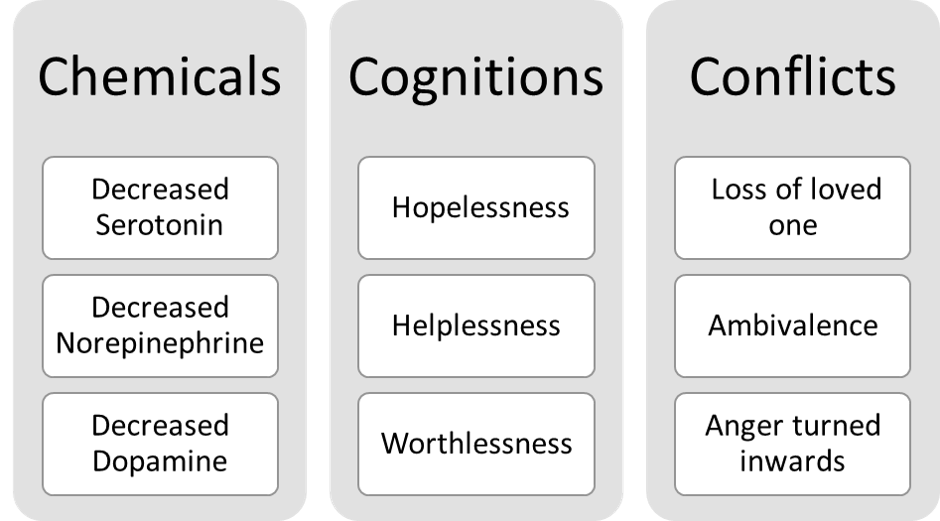
Choosing an antidepressant:
- Based on primary symptom remission
- Based on side effect profile
- Based on effectiveness
Augmentation strategies:
- Combining antidepressants
- Thyroxine
- Lithium
- Antipsychotics
- Modafinil
- ECTs
- Light therapy
Effective psychotherapies in Depression:
- Cognitive Behavioural Therapy (CBT)
- Interpersonal Psychotherapy
- Psychodynamic psychotherapy
- Solution focussed psychotherapy
Somatic therapies useful in Depression:
- Electroconvulsive therapy (ECT)
- Repetitive Trans Magnetic Stimulation (rTMS)
- Vagal nerve stimulation
- Light therapy
- Deep brain stimulation
Bipolar disorder

Difference between mania and hypomania:
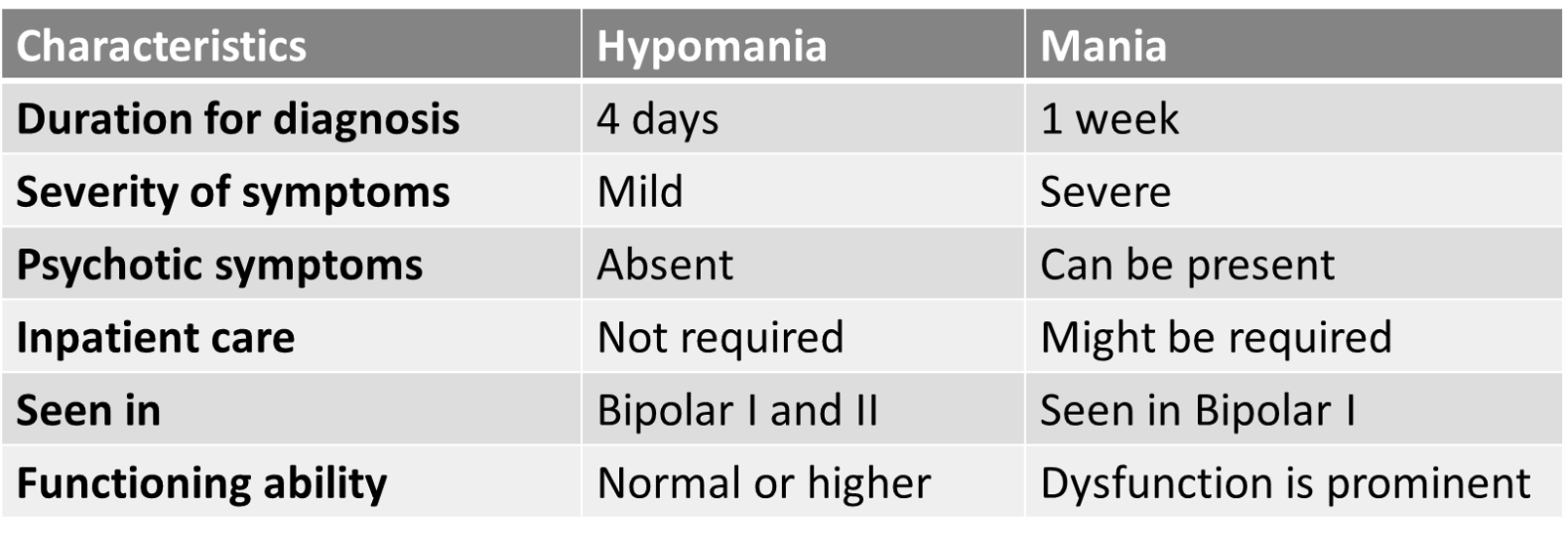
2 important types of Bipolar disorder:
- Bipolar type I
- Bipolar type II (patients of episodes of depression and hypomania only)
Important chromosomes related to Bipolar Disorder:
- Chromosome 18
- Chromosome 21
- Chromosome 22
Factors negatively influencing the prognosis of mood disorders:
- Long duration of episodes
- Psychotic symptoms
- Premorbid personality traits or disorder
- Persistent psychosocial issues
- Comorbid medical conditions like anaemia, diabetes or any other form of chronic or disabling illness
- Substance use disorder
- Poor functionality in between the episode
- Persistent residual symptoms
Management of Bipolar Disorder:
- Understand the nature and severity of the current episode and acutely manage the symptoms
- Important drugs for acute management of bipolar disorder are:
- Mood stabilizers - Lithium, Valproate, Lamotrigine, Carbamazepine
- Antipsychotics - Risperidone, Olanzapine, Aripiprazole, Quetiapine
- Antidepressants (under cover of mood stabilizer) for managing depressive symptoms
- ECTs can be considered for very severe symptoms
- Prophylactic treatment to prevent further episodes is by using mood stabilizers like Lithium, Valproate, Lamotrigine and Carbamazepine.
- Psychological interventions useful are:
- Insight facilitation
- Psychoeducation
- Interpersonal social rhythm therapy
- Cognitive behavioural therapy
Rapid cycling disorder:
- It is a type of bipolar disorder
- 4 or more mood episodes in a year
- The risk factors to develop rapid cycling disorder include:
- Female gender
- Hypothyroidism
- Comorbid substance use disorder
- Treated with antidepressants without cover of mood stabilizer
- Bipolar type II disorder
- Cyclothymia
- Hyperthymic personality
- Divalproate or valproate is the treatment of choice
Bipolar Spectrum
KLERMAN’S PRIMARY BIPOLAR SUBTYPES (Psychiatric Annals #17: January 1987)
- Bipolar I: Mania and depression
- Bipolar Il: Hypomania and depression
- Bipolar Ill: Cyclothymic disorder
- Bipolar IV: Hypomania or mania precipitated by antidepressant drugs
- Bipolar V: Depressed patients with a family history or bipolar illness (Genetic Bipolar Disorder)
- Bipolar VI: Mania without depression [Unipolar maniaj
AKISKAL’S SCHEMA OF BIPOLAR SUBTYPES (Psychiatric Clinics of North America 22:3, September 1999)
- Bipolar I: Full-blown mania
- Bipolar I ½: Depression with protracted hypomania
- Bipolar Il: Depression with hypomanic episodes
- Bipolar Il ½: Cyclothymic disorder
- Bipolar Ill: Hypomania due to antidepressant drugs
- Bipolar Ill ½: Hypomania and/or depression associated with substance use
- Bipolar IV: Depression associated with hyperthymic temperament
- Bipolar V: Recurrent depression and dysphoric hypomania episodes
- Bipolar VI: Depression that progressives to a dementia-like disorder
Suicide
- Every 40 seconds one individual succumbs to suicide, globally.
- Every 4 minutes one individual succumbs to suicide, in India.
- Suicide attempts are 10-20 times the actual suicide rates.
- 10.3 suicides per one lakh population is the suicide rate in India.
- 0.9% of the population have active suicidal ideation.
- Males succumb more to suicide than females, M:F::2:1.
- Presence of mental illness increases the risk of suicide.
- Mood disorder - 15% individuals succumb to suicide
- Schizophrenia - 10 - 12% individuals succumb to suicide
- Substance Use Disorders - 10% individuals succumb to suicide
- Borderline personality disorder - 10% individuals succumb to suicide
- Anorexia nervosa - 10@ individuals succumb to suicide
- Unemployed, single, divorced, widowed, and separated status of an individual can increase the risk of suicide.
- Access to means and methods increases risk of suicide
- 2 drugs which have antisuicidal ability:
- Lithium
- Clozapine
- ECT is useful in patients who are extremely suicidal.
Note:
Parasuicide is the behavior of harming one self with no intention to die. It is also called as Deliberate Self Harm (DSH).