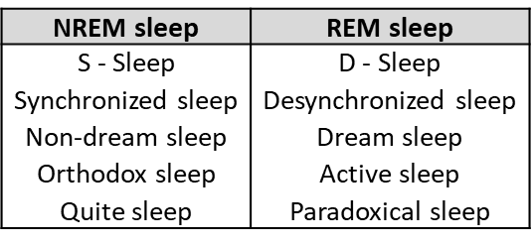
Synonyms of NREM and REM sleep
Maximum duration spent in...
In a 8 hours of night sleep an average adult spends, the percentage of duration spent in each of the phases of sleep are as shown in the picture below:
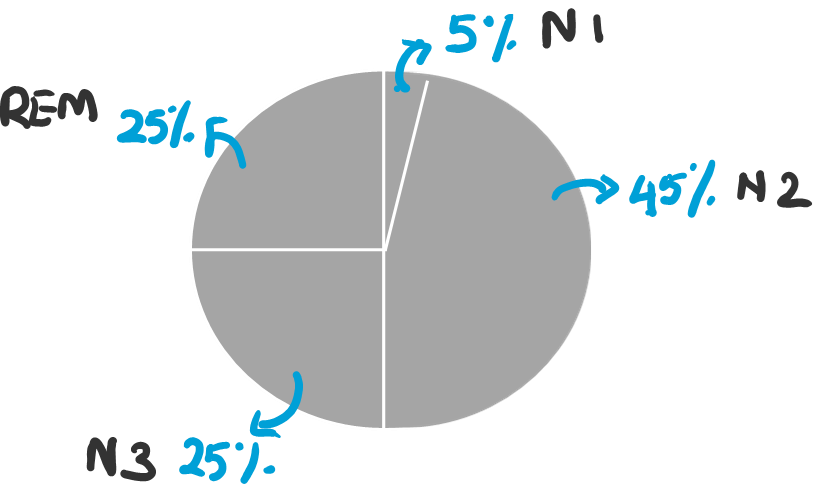
- Micro sleep or hypnic jerks are seen in N1.
- Bruxism is more in N2 stage of sleep.
- The maximum threshold to awaken an individual is seen in N3 stage of sleep.
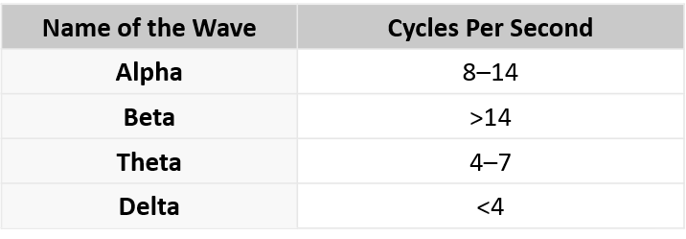
EEG waves in sleep
Note:
1. Saw tooth appearance of waves is seen in REM sleep.
2. N3 stage of NREM sleep is also called as 'delta' or 'slow' wave sleep.
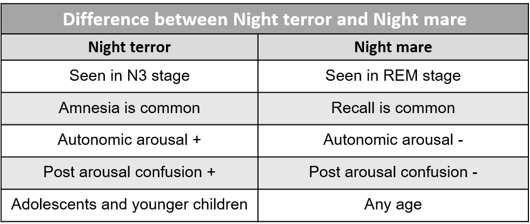
Night terror vs. Night mare
Note:
Night terror is also called as pavor nocturnas.
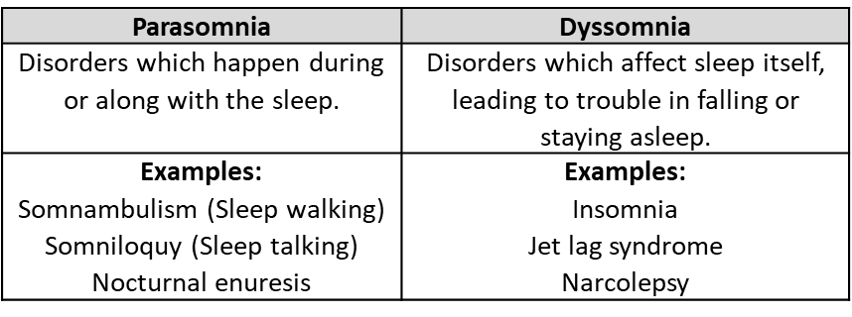
Parasomnia vs. Dyssomnia
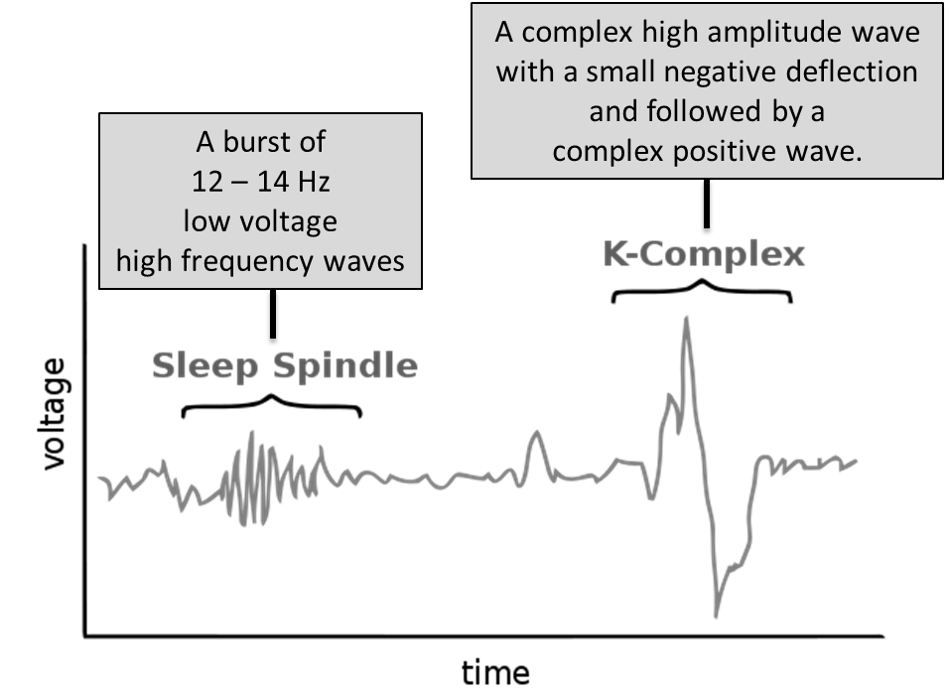
Sleep spindles and K Complexes
Sleep spindles and K complexes are characteristic features seen in N2 stage of NREM sleep.
Narcolepsy (Sleep attacks)
- It is a type of dyssomnia, characterized by abrupt episodes of REM sleep during daytime.
- Characteristic features are cataplexy, sleep paralysis, hypongogic/hypnopompic hallucinations, and decreased sleep latency.
- Often associated with DQB1*0602 or HLA-DR2.
- Dysfunction of the hypothalamic hypocretin/orexin system is involved in the pathophysiology of narcolepsy.
- Mean sleep latency of < 8 minutes and decreased REM latency.
- Two or more sleep-onset REM periods (SOREM).
- Lower CSF levels of Hypocretin/Orexin
- Management:
- Stimulant like medications Methylphenidate, Dextroamphetamine and Modafinil (α1-adrenergic agonist)
- Cataplexy and sleep paralysis are managed by TCAs and SSRIs
Kleine levine syndrome
A rare clinical syndrome, characterized by:
- Hypersomnia
- Hyperphagia
- Hyperorality
- Hypersexuality
- Irritability and associated behavioural disturbances
- Psychotic symptoms
There is no one specific treatment strategy. Some of the drugs useful are lithium, carbamazepine and benzodiazepines.
Restless leg syndrome (RLS)
It is also called as Ekbom syndrome Delusional Parasitosis.
RLS is common sensorimotor disorder, commonly seen in 5-15% of the population. It commonly affects the females and after forty years.
The 4 salient diagnostic features are:
(1) Urge to move limbs, commonly associated with premonitory sensory discomfort
(2) Motor restlessness
(3) Relief by activity
(4) Evening/Night worsening
Two most common pathophysiological explanations or mechanisms attributed are:
(1) Dysregulation of dopamine transmission
(2) Intracellular iron dysregulation {This can be objectively substantiated by decreased CSF ferritin and Prohepcidin (Intracellular regulatory protein for iron) levels}
The two common types of RLS described are:
Primary
Secondary
The common associated conditions are:
Iron deficiency
Uremia
Pregnancy
FDA approved drugs and modalities are:
Ropinirole
Pramipexole
Transdermal Rotigotine
Gabapentin Enacarbil
Relaxis pad (Counter-stimulation pad)
PLMS (Periodic Limb Movements of Sleep):
70% of RLS patients have PLMS.
Here unilateral or bilateral movements are seen.
The movements are mostly flexion movements at joints and of 0.5 - 1s duration.
Check out the video on Restless Leg Syndrome @ https://youtu.be/f8smMMXfq98
Nocturnal enuresis (Bed wetting)
A diagnosis is considered when a child of minimum 5 years of age, having atleast 2 episodes of bed wetting in a week for the past 3 months. It is more common in boys and the prevalence decreases with age, with less than 1% persisting with these symptoms even after 15 years of age.
Non-pharmacological management:
- Fluid restriction at night
- Star charting
- Alarm system
Pharmacological management:
- Desmopressin, an ADH analogue is the drug of choice.
- Imipramine, a TCA's anticholinergic effect can cause urinary retention.
Check out this video on Non-organic enuresis @ https://youtu.be/gHLhuuuV9TU