What is binge eating?
Binge eating is characterized by:
(1) Eating beyond comfort and fullness
(2) Eating in isolation
(3) Eating large amounts even when not hungry
(4) Post eating guilt
(5) Eating rapidly
Note:
Earlier binge eating was considered significant for diagnosis if it happened twice a week. In DSM 5, binge eating once a week for a consistent 3 months is considered as significant diagnostic criteria.
Important eating disorders
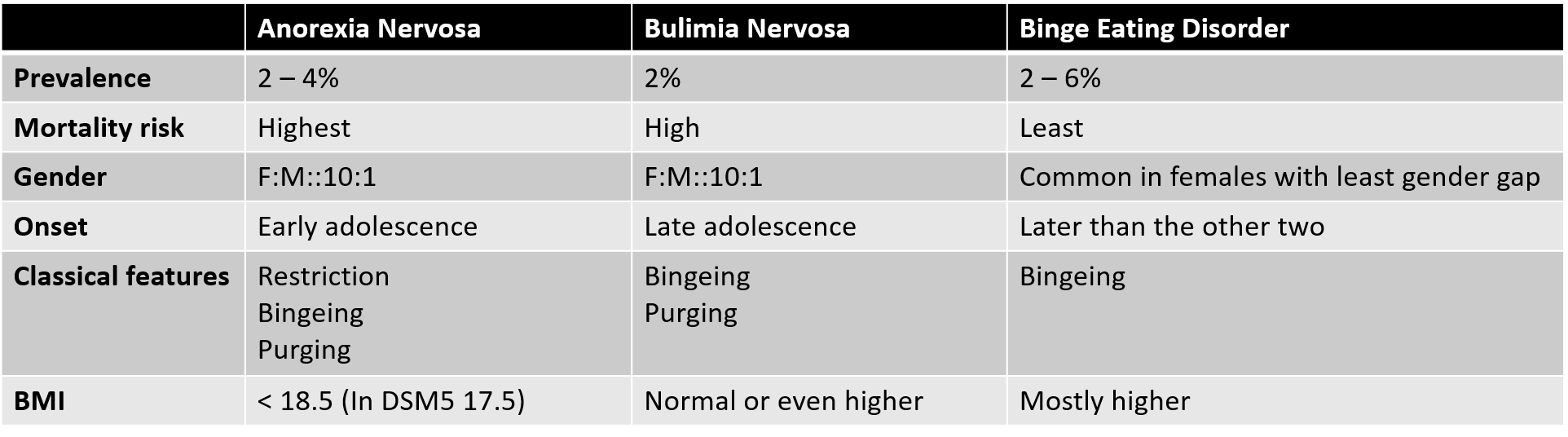
SCOFF Questionnaire
SCOFF questionnaire is a screening tool for Eating Disorder. This 5-question screening tool is sensitive to pick possible cases of anorexia nervosa and bulimia nervosa. The 5 questions are:
(1) Do you make yourself Sick because you feel uncomfortably full?
(2) Do you worry you have lost Control over how much you eat?
(3) Have you recently lost more than One stone in a 3-month period?
(4) Do you believe yourself to be Fat when others say you are too thin?
(5) Would you say that Food dominates your life?
One point for every “yes”; a score of ≥2 indicates a likely case of anorexia nervosa or bulimia.
One stone = 6.35 kg
Important complications related to Anorexia Nervosa
- Medical - Metabolic changes, infections
- Hematological - anemia, leucopenia
- Dermatological - Lanugo hair, thinning of hair, carotenemia
- Orthopedic - Osteoporosis
- Endocrinal - Hyperprolactinemia, Hypothyroidism, Hypercortisolemia
Note:
Laxative abuse can lead to metabolic acidosis rather than alkalosis, which is commonly seen in these patients with purging.
Important complications related to Bulimia Nervosa
- Retching
- Parotid gland swelling
- Dental caries
- Russell's sign (callouses on the knuckles or the dorsum of the hand)
- Mallory weiss syndrome
Refeeding syndrome
Aggressive refeeding of patients with anorexia can lead to its own complications called Refeeding syndrome.
Important biochemical changes in refeeding syndrome are:
- Hypophosphatemia
- Hypomagnesemia
- Hypokalaemia
- Glucose intolerance
- Thiamine deficiency
Pica
- Persistent eating of non-nutritive substances, atleast twice a week for more than a month.
- Patient’s chronological and mental age must be more than 2 years.
- Commonly associated with mental retardation, psychosis, anaemia and social deprivation.