The most......
The most prevalent psychiatric illness:
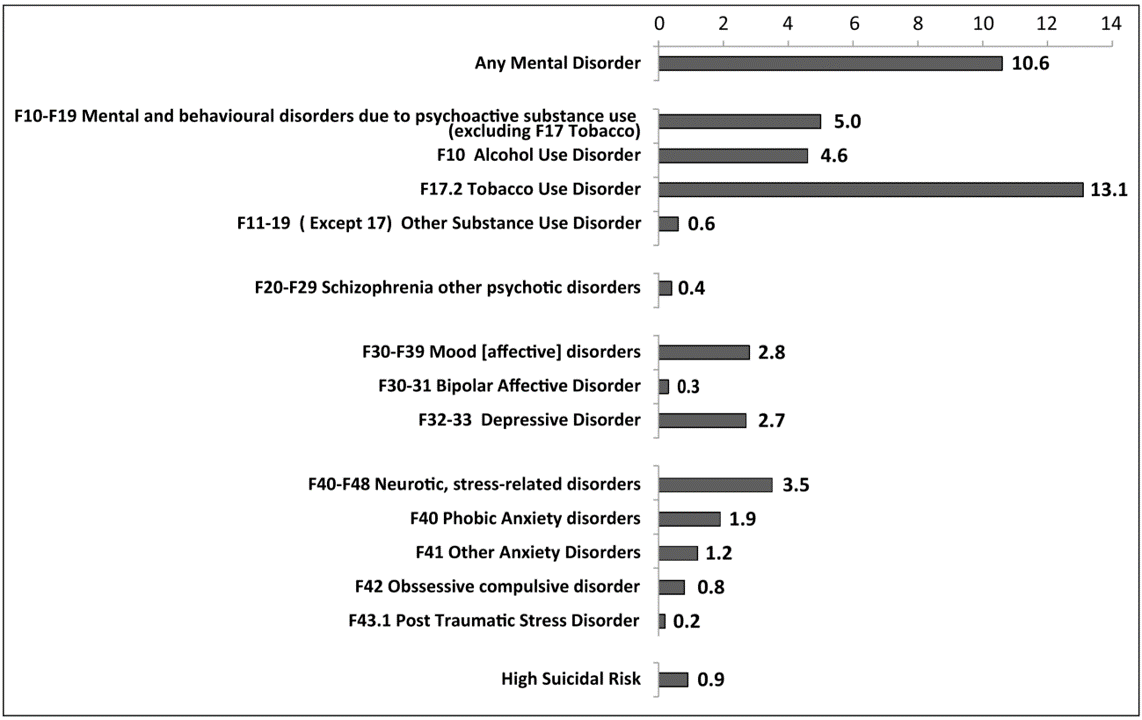
1. The most prevalent is Tobacco Use Disorder in specific and Substance use disorder in general.
2. The second most prevalent is Depression.
3. If all neurotic, stress and anxiety disorders are clubbed it pips over depression, to become more commoner.
4. Suicidal behavior is common. 0.9% has high suicidal risk.
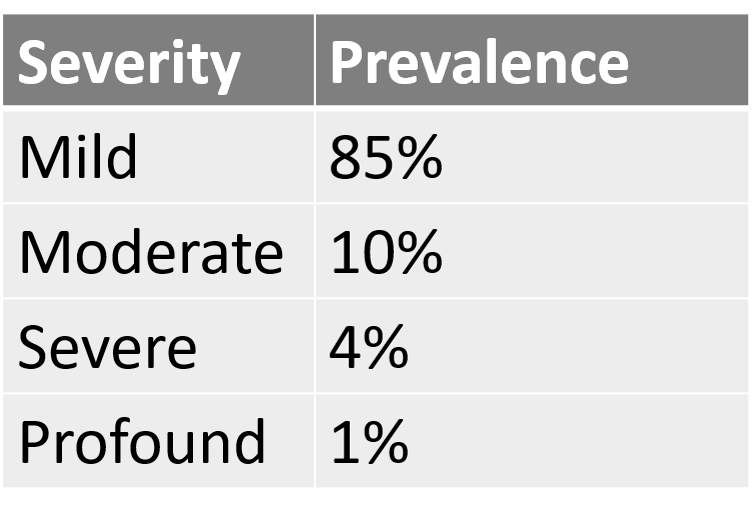
The most prevalent Intellectual Developmental Disorder:
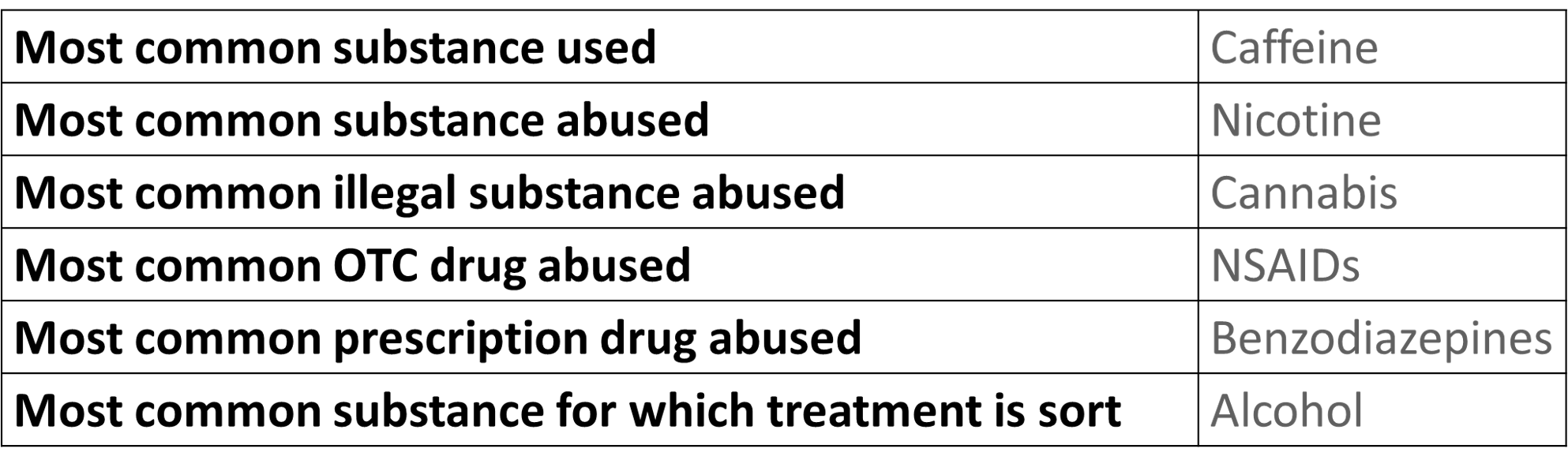
The most prevalent substance use:
Mc Naughten's rule
Mc Naughten was suffering from paranoid schizophrenia. He had delusions that the then British Prime Minister, Sir Robert Peel. was all out to kill him and hence went to assassinate him, in the process injuring his secretary. He was held and acquitted during court trial, as he was found ‘not guilty’ as he was found ‘insane’. The rules subdequently framed were called Mc Naughten’s Rule.
Note:
The law presumes everyone to be sane, until proved otherwvise. The burden of proof lies on the defence to prove.
Lucid interval is the period of normalcy between episodes of illness. It is commonly described in two contexts - mental illness (normal functioning time between two episodes) and head injury (period of normalcy between impact and loss of consciousness).
IPC 82,83, 84, 85,86
IPC 82:
'Act of a child under 7 years of age' — Nothing is an offence which is done by a child who, at the time of doing it, is under 7 years of age.
IPC 83:
'Act of a child above seven and under twelve of immature understanding'. —Nothing is an offence which is done by a child above seven years of age and under twelve, who has not attained sufficient maturity of understanding to judge of the nature and consequences of his conduct on that occasion.
IPC 84:
'Act of a person of unsound mind' — Nothing is an offence which is done by a person who, at the time of doing it, by reason of unsoundness of mind. ¡s incapable of knowing the nature of the act, or that he is doing what is either wrong or contrary to law.
IPC 85:
'Act secondary to involuntary intoxication' - Nothing is an offence which is done by a person who, at the time of doing it. is. by reason of intoxication incapable of knowing the nature of the act, or that he is doing what is either wrong. or contrary to the law: provided that the thing that intoxicated him was administered to him without his will or against his knowledge.
IPC 86:
'Assumed accountable for acts done secondary to voluntary intoxication' - In cases where an act done is not an offence unless done with a particular knowledge or intent, a person who does the act in a state of intoxication shall be liable to be dealt with as if he had the same knowledge as he would have had if he had not been intoxicated, unless the thing which intoxicated him was administered to him without his knowledge or against his will.
Mental Health Care Act 2017
The following procedures are prohibited:
- All other forms of ECT, other than modified ECT
- ECTs in minor
- Chaining
- Sterilization procedure, when intended as treatment for mental illness
Section 115 of the MHCA 2017:
Any person who attempts to commit suicide shall be presumed, unless proved otherwise, to have severe stress.
Government shall have a duty to provide care, treatment and rehabilitation to a person, having severe stress and who attempted to commit suicide, to reduce the risk of recurrence of attempt to commit suicide.
Note:
IPC 309 dealing with suicide attempt is scrapped. But, IPC 306 dealing with abatement of suicide is still active.
Important sections of MHCA related to admission:
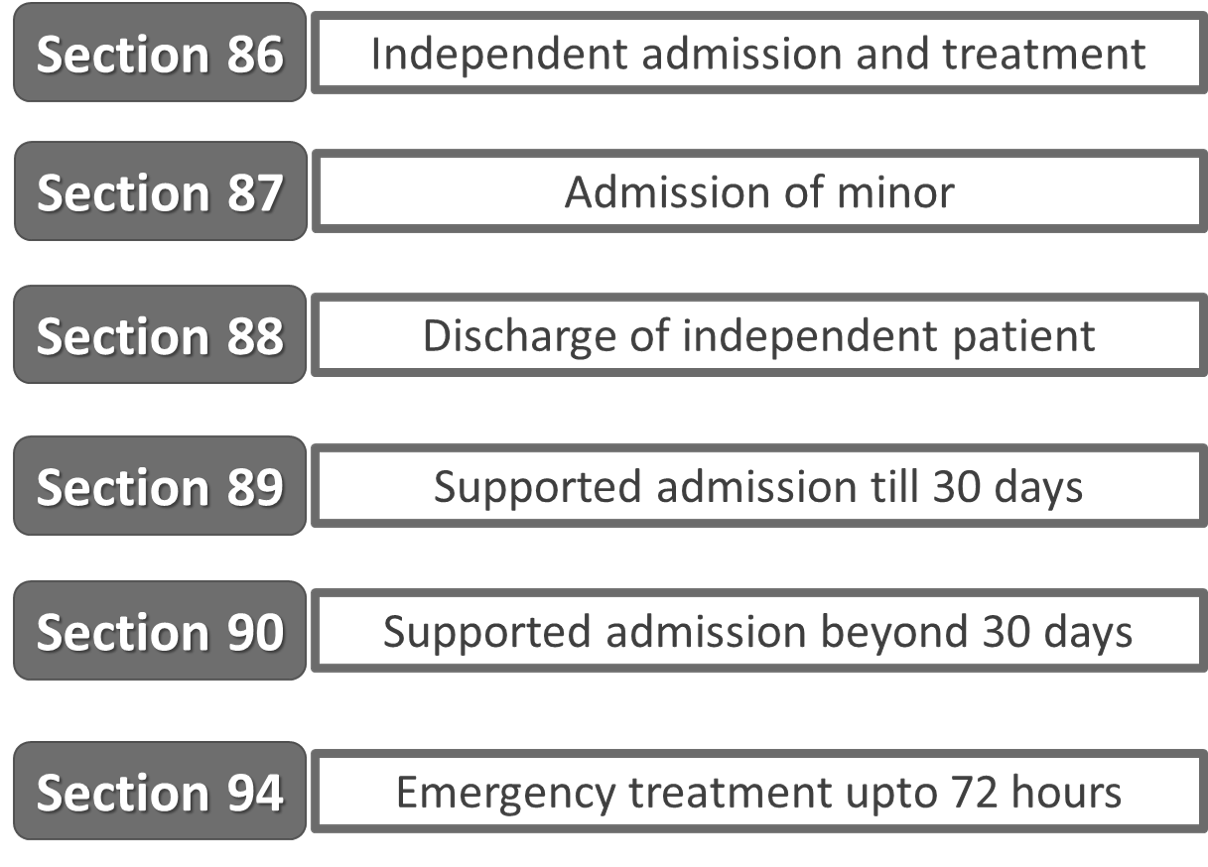
Extension of supported admission after 90 days can be done in the following manner (Section 90):
- 1st extension - 90 days
- 2nd extension - 120 days
- 3rd and more extension - 180 days
Information about admission to Mental Health Review Board (MHRB):
- Minor admission should be informed within 3 days of admission
- Woman admission should be informed within 3 days of admission
- Extension of admission of minors beyond 30 days should be informed
- All other admissions should be informed within 7 days
Advanced Directive:
The individual with mental illness can create his own advance directive. Which shall be a registered document under the MHRB and covering 3 important aspects about the mental health care delivered to the individual.
3 important aspects an advance directive shall cover are:
1. How one wants to be treated.
2. How one does not want to be treateed.
3. Who shall be a nominated representative, when the individual loses capacity.
Nominated representative:
A consenting adult who has been mentioned in an Advanced Directive and who shall represent and take decisions on behalf of the individual when he/she loses capacity.
Rights of Persons With Disabilities act (RPWD)
Important rights in relation to the RPWD act 2016 are:
- Free education (6 – 18 years) for children with benchmark disability
- 4% reservation in government jobs
- No procedures can be performed which leads to infertility without their free and informed consent
- Polling stations and material are to be barrier free
- No child can be separated from the parent(s) on grounds of disability, until there is a court order for a specific reason
The four important psychiatric disorders included in the RPWD Act 2016 are:
- Disorder of intellectual development
- Mental illness
- Autism
- Learning disability
The three neurological disorders included in the RPWD Act 2016 are:
- Epilepsy
- Parkinson disease
- Multiple sclerosis
The three blood disorders included in the RPWD Act 2016 are:
- Haemophilia
- Thalassemia
- Sickle cell disease
Check out this video on 10 important aspects about RPWD @ https://youtu.be/WBQAhMWVfcE
Cigarette and Other Tobacco products Prohibition Act (COTPA)
- Sale of tobacco to individuals less than 18 years is prohibited.
- Smoking in common public places are prohibited, except in designated smoking zones.
- Advertisements related to tobacco are prohibited.
- Sale is banned within 100 meters radius of educational institutions.
- Pictorial warning on the packs should be >85% of the display area.
Prohibition of Child Sexual Offences Act (POCSO)
- Mandatory reporting
- Gender neutral
- Child friendly and covers children upto 18 years of age
- Quicker and more stringent process
- 2 types of sexual offences:
- Sexual harassment
- Sexual assault
- Sexual assaults can be further into two types:
- Penetrative sexual assault
- Aggravated sexual assault (The perpetrator uses position, power or relationship against the involved child)
Narcotics, Drugs and other Psychotropic Substances Act (NDPS)
Two important quantities specified by the central government as an official gazette are:
- Small quantity
- Commercial quantity
The severity of punishment is based on the quantity seized.
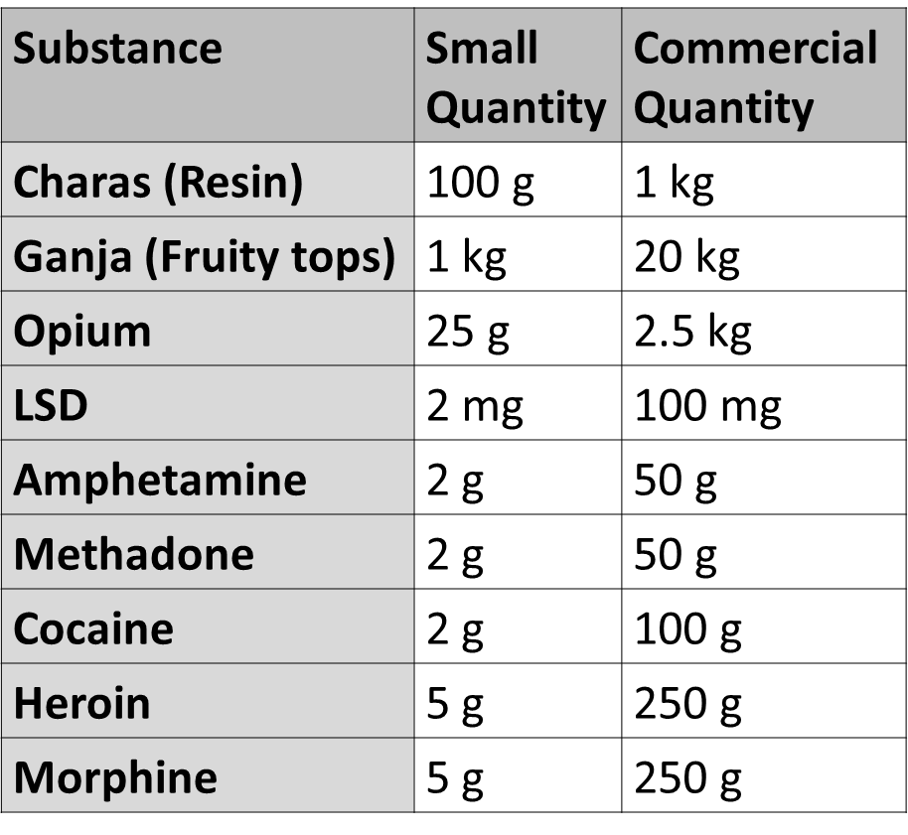
List of important drugs and their small and commercial quantity are: